
For senior operations managers, freight control is won or lost in the handovers.
A collection request moves to waybill capture. A waybill moves to manifesting. A trip moves to driver debrief. A completed delivery moves to POD capture. A POD moves to billing. Each handover needs the right information to move with it.
When that information is delayed, incomplete or sitting in a separate system, the workflow slows down. Drivers wait for clarity. Customer service chases updates. Finance waits for proof. Management only sees the pattern once the month-end report is compiled.
For finance managers, those same handovers affect billing accuracy, invoice turnaround and cash flow visibility. A shipment may have moved, but if the POD is missing, the rate needs to be checked manually, or the supporting detail is not linked to the invoice, the financial workflow remains incomplete.
That is why a freight management system matters. It gives those handovers a clearer structure, helping logistics businesses manage shipments, exceptions, PODs, billing and reporting through one connected workflow.
Where a freight management system improves operational control
A freight management system helps bring structure to the operational flow that sits behind every shipment.
Without that structure, freight teams often rely on individual knowledge, manual follow-ups and separate records. Rather – Operations may know that a parcel has moved, but customer service may not have the latest status, finance may still be waiting for the POD, and management may only become aware of the issue once a report has been manually compiled.
The issue is not always that teams are doing anything wrong. In many cases, the process has simply outgrown the tools being used to manage it.
This becomes especially clear when shipment volumes increase. More collections need to be captured. More waybills need to be checked. More drivers need to be debriefed. More PODs need to be matched. More invoices need to be processed. Every manual handover creates another point where information can be delayed, duplicated or missed.
A freight management system software environment helps reduce that pressure by giving each stage of the freight workflow a clearer place in the process. It does not remove the need for operational discipline. It supports it by making the right information easier to capture, track and act on.
Why improving shipping operations starts before dispatch
Improving shipping operations does not start when the vehicle leaves the branch. It starts when the job is captured.
If the customer, address, service level, weight, volume, rate, delivery instruction or collection detail is wrong at the start, the rest of the shipment workflow carries that error forward. The mistake may only become visible during delivery, POD matching, billing or customer query resolution, but the source of the problem is usually upstream.
This is why job capture and waybill control are so important.
A waybill is more than an operational reference. It becomes the record that connects the shipment to tracking, ePOD, billing and reporting. If the waybill is incomplete or inaccurate, customer visibility and financial control are both affected.
For operations managers, this creates delivery and service risk. For finance managers, it creates billing and margin risk.
A stronger freight management system should support:
When these steps are connected, the business has a better chance of preventing errors before they reach the customer or the invoice.
Reducing delays in logistics means finding where delays start
Reducing delays in logistics is not only about knowing that a delivery arrived late. By that point, the delay has already affected the customer, the driver schedule, the billing cycle, or all three.
For senior operations managers, the more useful question is where the delay first entered the workflow.
In freight operations, delays often start long before the vehicle reaches the customer. A collection may be captured without the correct service detail. A waybill may move forward with missing delivery information. A parcel may pass through a branch without the right scan. A driver may leave with a trip sheet that does not match the actual freight loaded. A POD may be captured late, leaving finance unable to close the job for billing.
Each of these points is a handover. When the handover is not controlled properly, the next team in the workflow inherits the delay.
This is where manual processes become difficult to manage at scale. A phone call may solve one missing update. A spreadsheet may help one branch reconcile a day’s movement. An email may confirm one exception. But across a busy freight operation, those workarounds create a process that depends on people chasing information rather than the system carrying it forward.
The most important delay points to review are:
- How quickly collections are captured, validated and allocated
- Whether waybills carry the correct customer, service, delivery and rating detail from the start
- Whether freight is scanned consistently through branch, floor and delivery milestones
- Whether manifesting and trip sheets reflect the actual freight being moved
- How clearly delivery exceptions are logged and followed up
- How quickly PODs are captured, scanned or linked to the correct waybill
- Whether billing is delayed by missing proof, incorrect rates or manual quality checks
- Whether customer service can access shipment status without depending on operations for updates
A freight management system helps by creating a more reliable operational record across these handovers. Collection, waybill, manifesting, debrief, POD, billing and invoicing data sit within the same workflow, giving operations and finance teams a clearer view of what has happened, what is still outstanding, and where the delay needs to be addressed.
The value is not only faster delivery. It is better control over the process that determines delivery performance, billing readiness and customer visibility.
The finance risk of a disconnected freight workflow
For finance managers, a shipment is not complete when it has been delivered. It is complete when it can be billed accurately, supported with the correct proof, and tracked through the debtor cycle.
In freight operations, finance delays often start with operational gaps. These gaps affect cash flow and reporting.
A freight management system software setup should help connect operations and finance so that delivery, POD, billing and invoicing data flow through the same structured process.
This is especially important where pricing is complex. Freight quoting software, customer-specific tariffs, weight-based rates, zone-based charges, fuel surcharges and special handling fees all need to be controlled accurately. If those rules are handled manually, the business becomes dependent on individual knowledge and manual checking.
How freight management software supports customer satisfaction
Customer satisfaction in freight is built on reliability and communication.
Customers want to know whether their shipment has been collected, where it is, when it will arrive, whether delivery was completed and where the POD is when they need it. When those answers are delayed, confidence drops quickly – even if the delivery itself was eventually completed.
This is where freight management software becomes a customer service tool as much as an operational system.
If customer service teams have access to shipment status, POD information, delivery exceptions and historic records, they can answer queries faster. If customers have portal access, load booking visibility or automated notifications, they are less dependent on calling or emailing for basic updates.
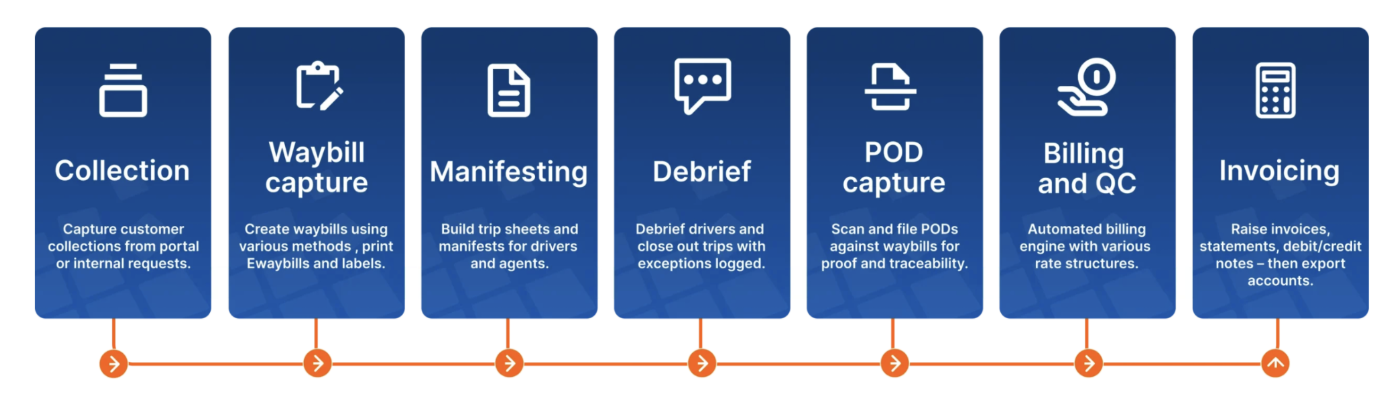
Winfreight’s Freight Management System is designed for courier and road freight operations, controlling the flow of information from customer site to invoicing and cash collection. The FMS workflow includes collection, waybill capture, manifesting, debrief, POD capture, billing and invoicing.
The customer impact is practical. Better visibility reduces uncertainty. Faster POD access reduces disputes. More accurate billing reduces queries. Cleaner delivery information helps the business protect service levels and customer relationships.
A self-assessment: does your business need a freight management system?
Use the questions below to identify whether your current freight workflow is giving you enough control.
- Are collections still captured through emails, calls or spreadsheets?
- Are waybills often corrected later in the process?
- Do customer service teams need to chase operations for shipment updates?
- Are PODs delaying billing?
- Are invoices held back because rates or delivery details need to be checked manually?
- Can you track shipment status by branch, driver, customer or service type?
- Are delivery exceptions being captured clearly enough to act on?
- Can finance see which jobs are ready to invoice without asking operations?
- Are customer queries taking too long because supporting documents are difficult to find?
- Is rate control dependent on one or two people who know the accounts well?
- Can management report on delays, billing exceptions and customer performance without manual reconciliation?
- Would higher shipment volumes put pressure on your current process?
If several of these questions expose gaps, the issue may not be effort. It may be that the freight workflow has outgrown the systems supporting it.
A good freight management system should help the business capture the right information once, move it through the operational workflow, and make it available for delivery, billing, customer service and reporting without constant manual intervention.
Let’s improve your freight workflow
If your freight team is moving shipments, but your customer service, finance and reporting teams are still chasing the information behind those shipments, the issue may be the workflow.
Winfreight helps courier and road freight businesses improve shipment visibility, reduce manual handovers, strengthen POD control and connect operations to billing.
FAQs
What is a freight management system?
A freight management system is software that helps logistics businesses manage the movement of freight from collection through to delivery, POD, billing and reporting. It gives teams better control over waybills, shipment tracking, driver debrief, customer updates and invoicing.
Why does a business need freight management software?
A business needs freight management software when manual processes start creating delays, billing errors, missing PODs, customer service gaps or reporting problems. The software helps connect operational and financial information so teams can manage shipments more accurately and efficiently.
How does a freight management system help with reducing delays in logistics?
A freight management system helps reduce delays by giving teams better visibility across collection, waybill capture, manifesting, dispatch, delivery, POD capture and billing. This makes it easier to see where freight is slowing down and to address issues before they affect customers or invoicing.
What is the difference between freight management software and freight management system software?
The terms are often used in similar ways. Freight management software usually refers to the digital tool, while freight management system software may refer to the wider system environment that supports workflows, users, reporting and integrations across the freight operation.
How does Freight quoting software support better freight management?
Freight quoting software helps businesses apply customer rates, service charges, destination rules, weight or volume calculations and surcharges more consistently. This improves quote accuracy, reduces billing disputes and supports better margin control.
Can a freight management system improve customer satisfaction?
Yes. A freight management system can improve customer satisfaction by giving teams faster access to shipment status, PODs, delivery exceptions and customer records. This helps customer service teams respond more quickly and gives customers clearer visibility over their shipments.
How does a freight management system support finance managers?
A freight management system supports finance managers by connecting PODs, rates, billing checks, invoicing and reporting to the operational workflow. This helps reduce invoice delays, billing errors, customer disputes and manual reconciliation between operations and finance.
How can Winfreight help with freight management?
Winfreight helps courier and road freight businesses manage the freight workflow from collection to cash collection. Winfreight FMS supports collection capture, waybill capture, manifesting, POD capture, billing, invoicing, customer visibility and reporting in one connected freight management environment.
Let’s move your business forward
Ready to streamline your logistics? Speak to our team today and discover how Winfreight can unlock efficiency in your supply chain.